DOWNLOAD AS PDF
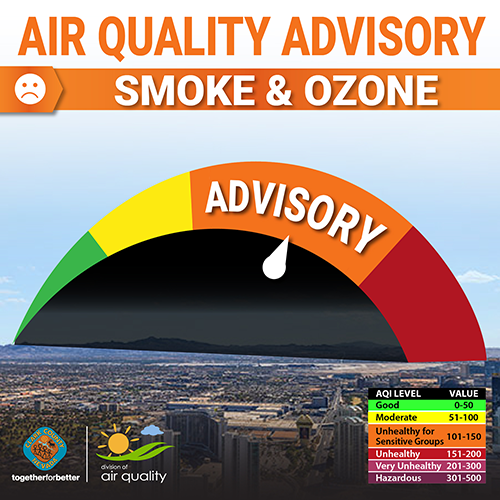
Clark County’s Division of Air Quality (DAQ) today issued a season-long advisory for ground-level ozone pollution and wildfire smoke, in effect April 1 through Sept. 30. Air quality forecasters say the increased chance of wildfire smoke drifting into Southern Nevada can influence ozone formation as well as increase particulate matter pollution.
Last year, DAQ recorded 18 days when ground-level ozone exceeded the U.S. Environmental Protection Agency’s National Ambient Air Quality Standards (NAAQS), down from 25 days in 2024.
Ozone is a colorless, odorless gas that exists naturally in the Earth’s stratosphere. At ground level, ozone is a key ingredient of urban smog that can build up during the day in the hottest months of the year due to strong sunlight, hot temperatures, gasoline and chemical vapors, pollutants from automobiles, wildfires and regional transport. Exposure to ozone can irritate your respiratory system and cause coughing, a sore throat, chest pain and shortness of breath even in healthy people, according to the EPA.
DAQ is also issuing a seasonal wildfire smoke advisory alongside the ozone advisory for the fourth consecutive year, as wildfires throughout the West have become more frequent in the summer months. Those fires have sent smoke billowing into Southern Nevada, impacting particulate pollution as well as ozone formation.
[more]
Seasonal Air Quality Advisory Issued for Ozone, Wildfire Smoke, cont.
Smoke is made of small particulates and other pollutants that can aggravate respiratory diseases and contribute to ground-level ozone formation. Exposure to smoke can induce coughing, wheezing and shortness of breath even in healthy people.
According to the EPA, people who may be most sensitive to elevated levels of particulates and ozone include individuals with respiratory problems, cardiac disease, young children and senior citizens. Consult your physician if you have a medical condition that makes you sensitive to air quality conditions.
SMOKE AND OZONE SAFETY TIPS
- Stay indoors when you smell or see smoke.
- Limit outdoor activity and exertion when ozone levels are elevated.
- Keep windows and doors closed. Run your air conditioner inside your house and car.
- Change your indoor air filters if they are dirty.
- Schedule activities for the morning or evening when ozone levels are usually lower.
- Always consult your doctor first for medical advice.
TIPS TO REDUCE OZONE
Because exhaust from cars, trucks and other vehicles are major contributors to ozone:
- Reduce driving – combine errands into one trip.
- Don’t idle your car engine unnecessarily.
- Use public transportation or carpool.
- Fill up your gas tank after sunset. Try not to spill gasoline when filling up. Don’t top off your tank.
- Keep your car well maintained.
- Consider landscaping that uses less water and gas-powered equipment to maintain.
- Turn off lights and electronics when not in use. Less fuel burned means cleaner air.
STAY UP TO DATE WITH LOCAL AIR QUALITY INFORMATION
###